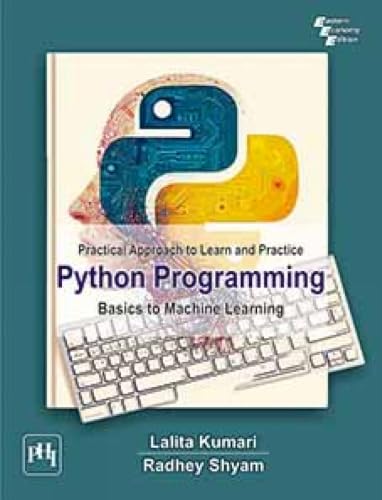
Practical Approach to Learn and Practice Python Programming Basics to Machine Learning / by Lalita Kumari and Radhey Shyam
Material type: TextPublication details: Delhi: PHI Learning Pvt. Ltd., 2025Description: p. XIV,249ISBN:
 - 978-93-5443-767-0
- 005.133 KUM-P
| Cover image | Item type | Current library | Home library | Collection | Shelving location | Call number | Materials specified | Vol info | URL | Copy number | Status | Notes | Date due | Barcode | Item holds | Item hold queue priority | Course reserves | |
|---|---|---|---|---|---|---|---|---|---|---|---|---|---|---|---|---|---|---|
 Books
Books
|
ARCHBISHOP KAVUKATTU CENTRAL LIBRARY | 005.133 KUM-P (Browse shelf(Opens below)) | Available | 69310 |
Preface
BASICS OF PYTHON
1. Introduction
2. Literals and Data Types
3. Variables and Operators
4. Interactive Input-Output
CORE PYTHON CONCEPTS
5. Control Flow
6. Functions
7. File Handling
8. Object-Oriented Programming (OOP)
9. Modules and Packages
10. Graph Plotting
MACHINE LEARNING THROUGH PYTHON
11. Introduction to Machine Learning
12. Data Preprocessing
13. Supervised Learning
14. Unsupervised Learning
Index
This comprehensive text on Python programming is designed for undergraduate and postgraduate students in Computer Science and Information Technology. Whether you are a beginner or have limited programming knowledge, this book offers a structured learning experience, starting with foundational concepts and progressing to complex topics like machine learning.
Divided into three parts, the book ensures a smooth progression from the basics and core concepts of Python to machine learning with Python. It covers fundamental topics such as data types, variables, operators, and interactive input/output, enabling readers to write simple yet effective Python programs. Subsequently, the text explores advanced concepts such as control flow, functions, file handling, object-oriented programming, modules, and data visualization through graph plotting, empowering readers to develop robust and complex Python applications. Finally, the book introduces readers to the world of machine learning, covering essential topics like data preprocessing, supervised and unsupervised learning, and algorithm implementation.
The book equips students to excel in Python programming and seamlessly transition into machine learning, enabling them to design and implement customized algorithms for their datasets.
There are no comments on this title.